Saturday, April 28, 2012

Table Mountain

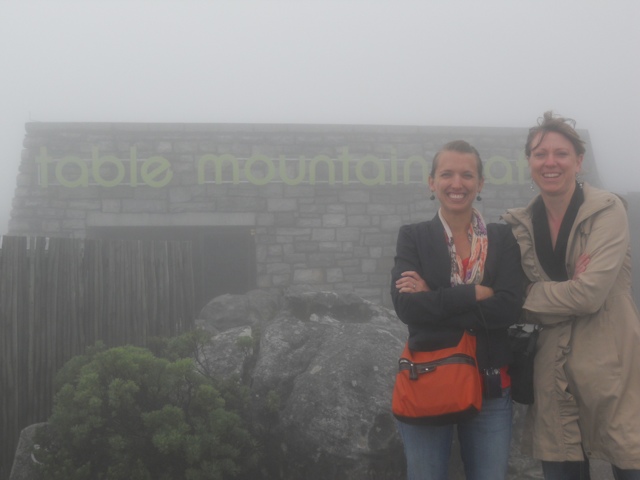
We left Jo'berg on Friday and arrived in Cape Town in the early afternoon. We went straight from the airport to Table Mountain. The mountain was covered in a cloud and cold! We took a cable car to the top. The cable car floor spun slowly which is nice so everyone gets to see each direction, but it made Dona sick! After walking around just a few minutes our hair was soaking. We did a short hike and saw a bunch of animals that we can't remember the name of, kind of like big cuddly rats.We had a snack in the cafe at the top. Dawn had ostrich sausage...she said it tasted like greasy sausage, not the best meal on the trip.

Friday, April 27, 2012

Orphanage


One of the best experiences of the whole trip was the visit to the orphanage.  Before we arrived at the orphanage we stopped by a grocery store to buy treats for the children.  Upon our arrival at the orphanage, the man in charge asked that we not give the children the candy until he said it was okay and not to give them any money.  He said that they were trying to teach the children certain values, and did not want the children to think that when they saw strangers enter their village that they should beg and expect handouts.  He needed for there to be some sort of exchange between us and the children before we gave them candy.

We were given a tour of the village, a shanty town.  As we walked through the dirt pathways between the shacks, we had to avoid stepping in the flowing streams of water that ran down the pathways.  One family of about 18 allowed us to enter their little 3 room shack; we could hear mice/rats running about between the slabs of wood and tin that acted as walls for the home.


Back at the orphanage, we were given directions to go to see the girls’ dormitory on the left.  When our group started walking to the room on the right, a teenage girl from the orphanage, in a gentle teasing manner, said to us in perfect English, “I see your English is not very good.  The girls’ dormitory is over there to the left.”

The orphanage also acted as youth center for the community with much focus placed on education.  Dona liked their little library.  The children had prepared a little skit with singing and dancing and performed for us.  At the end of the skit they grabbed everyone of in the audience so that we could dance with them.  What a beautiful exchange we had with these children.  The warmth, smiles and openness of these children despite their circumstances without a doubt touched the hearts of everyone in our group.
Dona and I held the cutest baby, he was probably about 14-16 months, and we both wanted to adopt him so badly.  We also spoke with a 20 year old girl.  She told us that she rode the bus to the city everyday to attend school and was studying human resources.  In our conversation with her, and as part of our assignment to speak with a local, we asked her what she thought was the biggest global issue.  She admitted that her view of the world is quite sheltered, but to her the biggest problem is unemployment (in South Africa the unemployment rate is around 25%).


As we were leaving the children all followed us to the bus.  Dona and I had our picture taken with the girl mentioned above and some other little children.  But I guess while getting our picture taken the little boy needed to go to the bathroom badly and turned to the side.  I had to quickly move my foot to avoid getting peed on. :)


Bike Tour Through Soweto


We started out bike tour at a youth hostel and went through a few different neighborhoods. On a bike the area was a lot hillier than it seemed like from the bus. We passed Nelson Mandela's and Desmond Tutu's houses as well as the square where the 1976 youth uprising happened. The uprising was students protesting against a change in the language of instruction in schools. The government had decided that everyone should be taught in Afrikans which not everyone spoke.

Dawn was so brave! She tried cow head and a traditional beer served out of a calabash. The beer comes in a paper carton, like a cardboard milk carton, that says don't drink and walk in the road you could be killed - it's own version of don't drink and drive. Lots of kids waved at us as we passed. Some gave us the thumbs up so when we gave the thumbs up back they touched their thumbs against ours. A Soweto greeting. The poverty is very sad. Within Soweto there is an upper, middle, and lower class but even the upper class isn't close to our standard of living. We passed the public bathrooms and a water pump. Most places don't have running water sanitation or electricity. If your house is cement instead of steel or tin walls you are doing well.

We had good tour guides who shared African songs and dances with us as well as the role music played in the history of Soweto. The guides also demonstrated the clicking language. The people that we passed were all very welcoming and friendly, waving and saying how are you as we biked past. Interacting with the people was our favorite part of the day. What a different experience from the stock exchange from the day before!

Wednesday, April 25, 2012


Johannesburg Stock Exchange

We had a very informative visit today at the Johannesburg Stock Exchange.  Some interesting things I picked up from the visit were:

  • The JSE has an index which provides investors with company rankings based on social issues.
  • The JSE is ranked as the highest regulated stock exchange in the world.
  • An advantage of being in an emerging market is that they can wait to see what does and does not work in other markets.  Ranking for financial soundness was 8 or 9.
  • Prior to the world financial crisis, South Africa was starting to see growth but that growth has stopped since the financial crisis.  However, the world financial crisis has made South African Bonds more attractive.
  • The droughts in Texas and Mexico has helped the agriculture industry in South Africa as the farmers here were able to step in and provide the products normally provided by Mexico and Texas.
  • South Africa is at a disadvantage to attract foreign direct investment compared to more developed countries as they do not have the financial resources to entice companies to make such investments in their country.


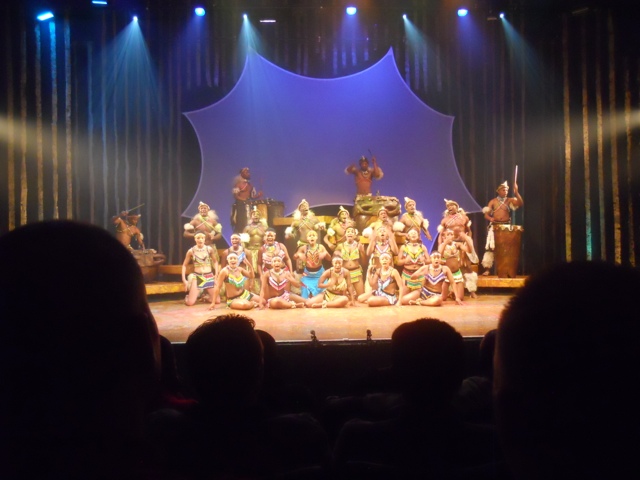
Umoja

Umoja: the spirit of togetherness
music and dance of South Africa through the ages.
http://www.africaumoja.com/

Dona: "fantastic"
Dawn: "amazing"

Soccer City

We visited Soccer City, the stadium where the 2010 world soccer cup was held. It is huge! It holds 90,000 people! It is built to look like a pumpkin, inside and out, to represent a traditional South African beverage - drinking beer out of a pumpkin. We entered the stadium through the media tunnel. Someone had rented out the entire stadium to shoot promotional videos so we had to steer clear of a large portion on the stadium. Our guide told us that someone had recently rented the stadium for a wedding. They must have been big soccer fans. The ceremony was in a VIP box, they are very particular about letting people walk on the pitch. The pitch is raised three steps from the ground. I hope the ball boys don't trip! The grey lines in the seats seem random at first but they point in the direction of other stadiums that were involved in the tournament- other South African stadiums and to Germany where the previous world cup was held.


Tuesday, April 24, 2012

National Youth Development Agency NYDA


This morning we visited the NYDA. We learned about what the agency does and a number of interesting facts about SA. SA is a country of contrast. We are staying in Sandton, a very nice place but there is another city very close called Alexandria which is one of the worst slums. This is interesting to us because the roads we have been taking out of town have been through very nice areas and it isn't until we get outside the city when we start seeing the shanty towns.

The agency was formed from two existing agencies on June 16, 2009 in remembrance of the June 16, 1976 youth uprising. Youth is defined as ages 14-35. The age goes so high because the agency wants to help those who didn't have opportunity prior to 1994 during apartheid. The agency provides business mentors, job training, micro loans for entrepreneurs and much more. One of the challenges they is they face is youth heads of households due to disease and other social factors. Check out their Facebook page.

https://www.facebook.com/pages/National-Youth-Development-Agency/177619079111

We also stopped by a market and loaded up on souvenirs. We thought we did a great job haggling until we got to the bus where there were a few more experienced hagglers that really got deals.

We are back at the hotel now but are leaving in a few minutes to a theatrical African show.


This is a picture of us on the way to the NYDA. We have been spending a lot of time at the front of the bus. You can see more from that seat! The other picture is of Prof Bunker telling jokes to entertain students on the long bus rides.